Post by: Vito Russo
This past week (6/8/26 – 6/12/26) was the Hockley team’s second week in the field! Last week, we established a grid for a walk-over survey and initial shovel test pits to determine the soil composition and potential for material culture. The project finally broke ground with our first shovel test pits on Monday, 6/8. Later in the week, our first volunteers joined us for some of our most challenging work so far! This is the second in a series of blogs detailing the team’s work: this week was all about shovel test pits.
In the case of our early shovel tests at Hockley, we began by working from our westernmost point northwards, following our established grid from the previous week. This ensured our test pits followed a consistent and systematic pattern.
We began shovel test pits by digging a small, rounded pit to gain a better idea of what soil deposition in the area is like and to see if there are any areas with a high density of material culture. We first put the topsoil we remove through a mesh screen, which removes loose dirt and leaves behind any artifacts or other larger objects for closer analysis. Once we determined if the topsoil we removed contained anything worth closer analysis, we cleared the screen and repeated the process as we dug farther down. We continued this process until we reached sterile soil (which contains no evidence of human activity). In our early test pits, much of our digging was stopped upon reaching rocky, impassable areas.
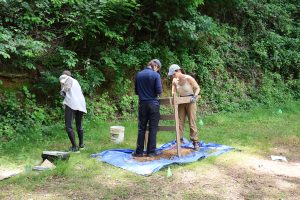
Because these initial pits are along the westernmost line of our grid, it is not entirely surprising that our pits encountered heavily rocky, sandy and silty layers. Over time, human and natural activity create distinct layers in the soil. These layers assist archaeologists in identifying the relative age of any material found within them. For example, if a glass shard and a ceramic piece are found within the same soil layer, we can often assume they were deposited around the same time. However, if the glass shard was found within a deeper soil layer than the ceramic piece, we can assume it was deposited earlier than the ceramic.
This line of test pits is located directly at the bottom of a steep incline, which has likely affected soil composition over the centuries. The area also served as a driveway later in the house’s occupation, further compacting the natural soil layers.
Still, despite rocky and unpredictable shovel tests, our work has revealed a few small artifacts so far: brick, ceramic and glass fragments, including whiteware, porcelain, and various pieces of window and vessel glass. And on Friday afternoon, as we moved eastward to begin a new line of test pits, our work revealed an artifact synonymous with Hockley’s early productive phase: a hand-wrought nail!
Location of artifacts is only part of the work; however, arguably more important is our documentation of the process. Each layer of soil within a test pit was measured, and its color and texture were recorded. Features within a test pit, such as an immovable stone, were recorded and measured as well. Any recovered artifacts are then sorted and stored according to the test pit’s location on the grid for future reference and processing in the lab and beyond.
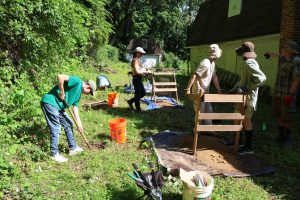
This week was also the first time the team faced significant weather-related challenges. Heavy rain put an early end to work partway through the week, and the end of the week brought high temperatures and thick humidity. In such conditions, it was important for us to take frequent breaks in shaded areas and drink a lot of water. Despite these setbacks, we ended the week on a high note with our latest test pits revealing an increasing number of the aforementioned artifacts. We could not have progressed nearly as far as we did without the help of our volunteers, who aided us in the particularly challenging end-of-week heat!
The team will continue shovel test pits with volunteers into week three as we close in on the areas that may have housed the summer kitchen and bake oven. From there, our work will extend down the hill from the forge master’s home to a lower terrace, another area with documented evidence of a past structure.
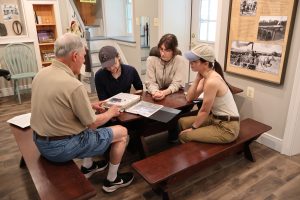
University of Maryland students hear from volunteer ranger Ed Johnson at the Patapsco Valley State Park Offutt History Center.
This project has been financed in part with State funds from the Maryland Historical Trust, an instrumentality of the State of Maryland. However, project contents or opinions do not necessarily reflect the views or policies of the Maryland Historical Trust.