Post by Alannah Rood & Olivia Wies
In our previous blog, we introduced the Hockley team’s shovel test pits, or STPs. These small excavations help us understand what lies beneath the surface and identify areas that may contain evidence or context of past activity. While artifacts are an important part of that work, the soil surrounding them can be just as informative.
Stratigraphy is the study of layers, or strata, that have built up in the ground over time. These layers may form through natural processes such as erosion or flooding; however, they may also result from human activities, including construction or the disposal of materials.
In an undisturbed area, lower layers are generally older than those above them. This principle is known as the “law of superposition.” Archaeologists use this to understand the order in which deposits formed. However, soil is rarely perfectly preserved. Erosion, agriculture, and construction can mix or shift soil deposits, making careful observation essential.
Each STP offers a narrow window into this underground history. As we excavate, soil is removed gradually and passed through a screen to recover artifacts and other materials. As we dig, we watch for changes in color, texture, compactness, moisture, and content. A dark, organic topsoil layer may give way to lighter sandy soil or compact clay. Gravel, charcoal, or brick may also help us understand how a layer formed.
Documentation is a major part of the process. For each layer, we record its depth, color (using a Munsell book), texture, and any unusual features on an STP sheet. Artifacts found are also documented here so that their original context may be reconstructed later. Once the pit is backfilled, these notes become a permanent record of what was found.
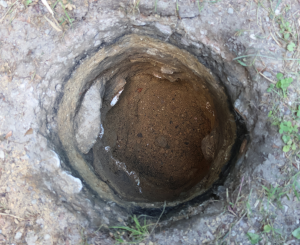
The soil deposition we uncovered this week was noticeably different from what we were encountering during week two. Last week we were excavating around 20 feet away from Hockley House, on what we are referring to as the A line. The B line is further east, and closer to the house. The soil in the A line STPs was filled with large rocks, and displayed only 2 distinct strata: top-soil and a sandy layer which continued down for as far as we were able to dig. In stark contrast to this, we observed as many as 9 distinct layers in many of the STPs on the B line.
Notably, we encountered a thin, gravelly, black layer close to the surface, in varying sizes across the B line. This is very likely a layer of burnt soil. There was also a layer with soil with a high clay content, leading to difficulty screening for material culture.
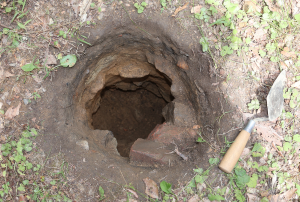
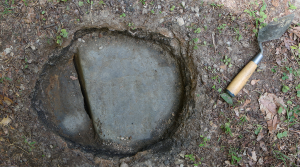
We were able to dig almost 3 feet down on multiple STPs on the B line this week. Compared to the A line, the STPs this week were far more productive in terms of material culture. We found an abundance of ceramic shards, pieces of metal, brick fragments and in two STPs, full intact bricks. On one of the final test pits we opened, there were two large stone slabs around 0.4 feet below the surface. These slabs were very thick, and took up the entirety of the pit, meaning we were not able to continue excavating in the area. Although we cannot further investigate these possible architectural remains for the time being, we may open up a full excavation unit in the future for further inquiry.
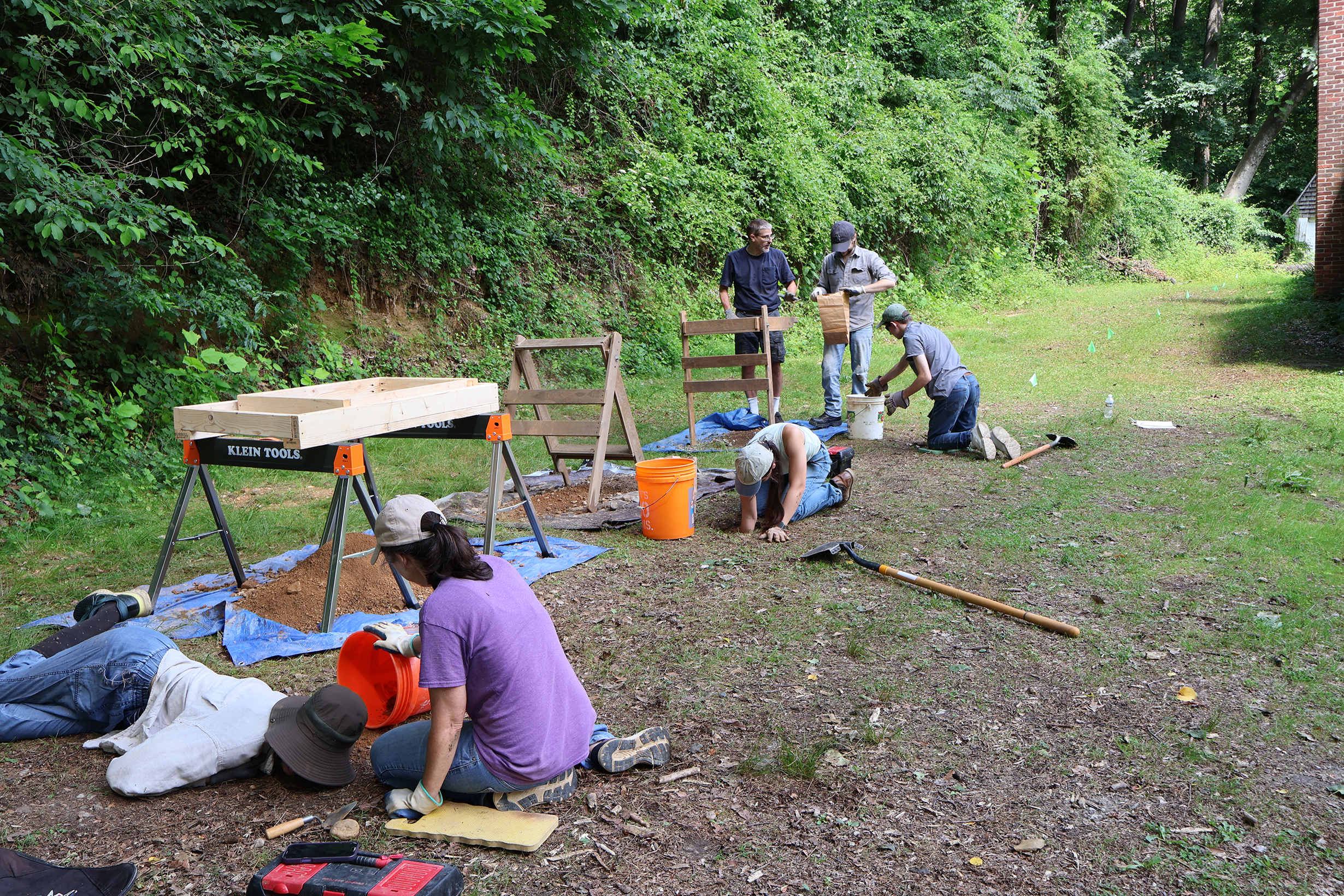
This was a productive week, partly due to the weather being more forgiving. We were able to work efficiently with the help of volunteers and made very good progress on shovel test pits!
This project has been financed in part with State funds from the Maryland Historical Trust, an instrumentality of the State of Maryland. However, project contents or opinions do not necessarily reflect the views or policies of the Maryland Historical Trust.