Post by: Olivia Wies
This was the team’s fourth week in the field (6/22/26-6/26/26), and one of our most productive in terms of material culture! In our previous blogs, we’ve discussed the process of digging shovel test pits and noting soil stratigraphy. This week, it’s finally time to talk about the artifacts we’ve been finding over the past few weeks. We’ve chosen two of our materially rich test pits to talk about, both on opposite ends of our first excavation grid.
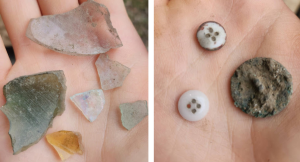
C1 is positioned on the far South side of our grid, in the area that we believe may have housed the summer kitchen. This area has been used as a driveway for many years, causing the soil to become very compact, leading to difficulty excavating the top layers. This, paired with us having to cease and resume excavation multiple times due to inclement weather, has made C1 quite the dramatic test pit to work on. Despite these difficulties, we were able to reach a depth of roughly 3ft, only stopping because we could no longer reach down to scoop out loose soil. Though we were able to use a soil probe to see another 2 inches or so past where we could reach, the probe hit what looked like a brick and was not able to go further to see if we could determine further soil changes beyond 3ft.
After excavating the compacted top layers, we began to unearth large pieces of red brick, glass, ceramic, and mortar, the latter of which we had not seen in any of the shovel test pits thus far. The types of artifacts we find at a certain location can help us to make interpretations about how the site might have been used in the past. For instance, artifacts like glass, ceramics, and brick tend to show up in domestic settings, whereas copious amounts of metal, coal or slag may point more towards a site that produced or used such materials. As we dug further down, we continued to find a large amount of brick and mortar as well as various burnt items. Among other things we found burnt ceramic, shell and bone, and for the first time, multiple buttons. This sort of material culture may indicate that this area was at some point being used as a trash pit, though this is just an early hypothesis rather than a definitive conclusion.
On the opposite side of the house is test pit C11. This test pit was unique for a variety of reasons. It was positioned far from the last pit we could do in the C-line before the line ran into the house, in a small garden on the north side of the house. We noted six distinct stratigraphy changes mainly consisting of sand and clay. Very soft and easily removable soil made the first foot of the test pit relatively easy to dig. Afterwards, we began to encounter large rocks that took time to dig under and out. Interspersed between the removable and non-removable rocks were two bricks in the south wall, spaced just less than a foot apart. Our excavation of the pit ended at a depth of 2.65’ because of a rock blockage.
The artifacts of C11 are incredibly diverse. There were two mostly intact bricks in addition to the bricks present in the pit’s south wall. There were three nails of different sizes, the largest pictured below. There were remains of a glass jar, of ceramic vessels, and of hand-painted white ware. One of the unique finds in C11 was a Buffalo Nickel, a coin minted from 1913-1938. Its design features a generalized Native American profile on the front side with an American Bison on the back. Upon close photograph this nickel appears to be from 1923, but we’ll be certain once we bring it to the lab next week!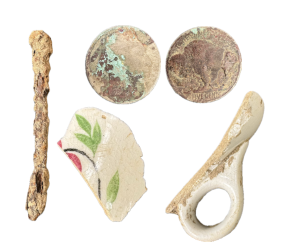
*Note: Photographs are not to scale; zoomed in for close detail
This project has been financed in part with State funds from the Maryland Historical Trust, an instrumentality of the State of Maryland. However, project contents or opinions do not necessarily reflect the views or policies of the Maryland Historical Trust.