Post by: Vito Russo
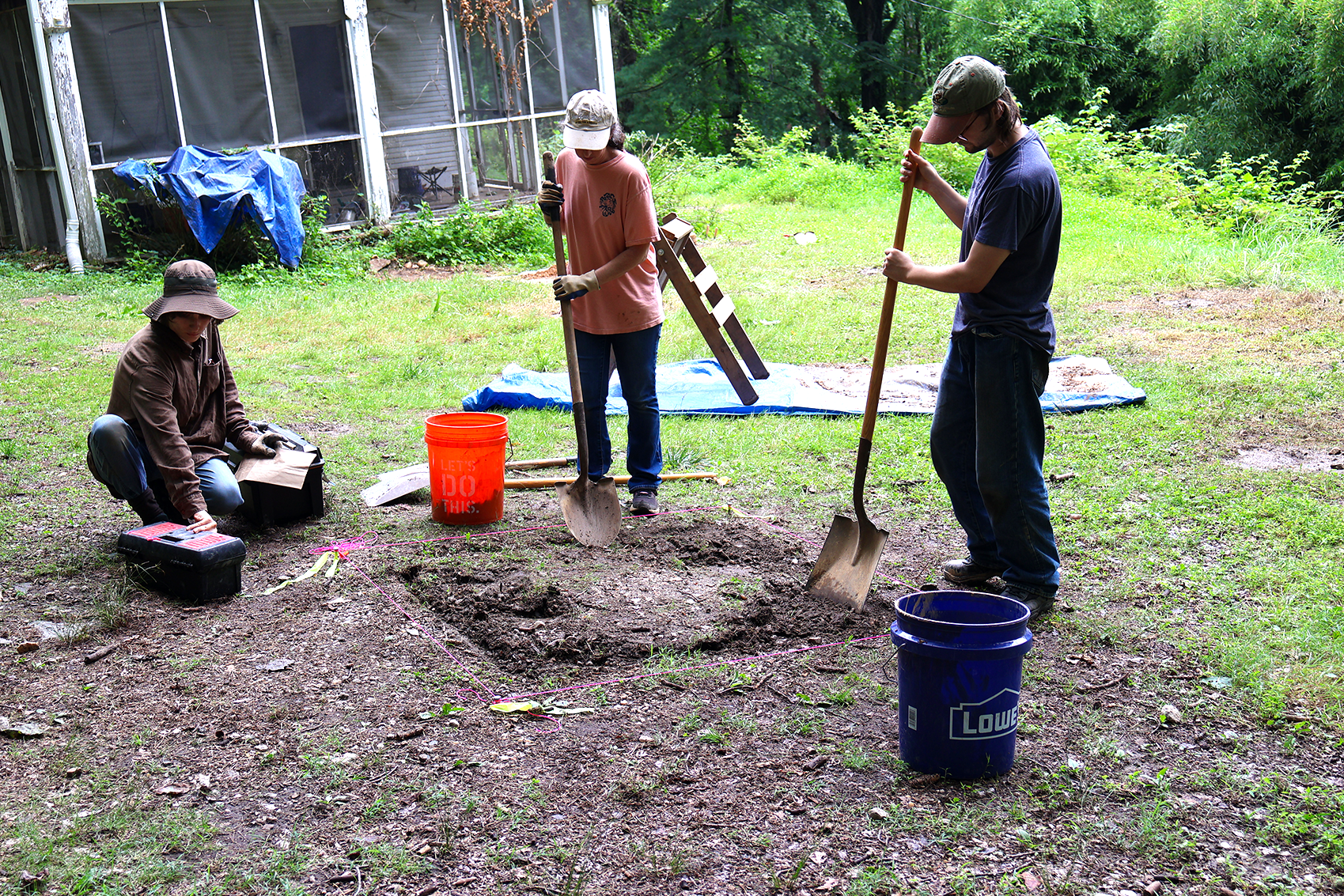
The final week of the UMD/PHG field school at Hockley House wrapped on 7/10/2026. In these last two weeks, we’ve focused on finishing our shovel test pits, visiting the lab, and finally opening our first excavation test units!
We’ve spoken in previous posts about the limitations of weather, be it the heat or the rain. As temperatures reached into the upper 90s on a few of our final days in the field, we took the opportunity to do an initial cleaning and begin cataloging our findings so far.
Cleaning is a long process if you have a sizable amount of artifacts, and depending on where you are, state laws require different methods. For instance, many of the potential nails we’ve found were encased in layers of dirt and stone. Cleaning with a wet brush may have wiped some of that debris away, but Maryland preservation guidelines require ferrous metals like the nails to be dry brushed to avoid damaging the heavily corroded metal.
We spent three days in the lab cleaning hundreds of artifacts, and afterwards, began to label them with relevant information. Some artifacts, like the aforementioned ferrous metals, do not require labels directly on them. Other small finds however, like a porcelain Prosser button, require the individual artifact labels. Apart from labels on an individual artifact, it’s also important to link the bag we place them in with other identifiable information that helps us identify the item’s provenience.
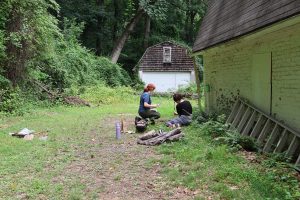
In our final week of the field school (not the final week of our excavations), we also began our first test units. In comparison to our shovel test pits that were meant to test small, localized areas for information on soil deposition and potential artifacts, these units are much larger (up to 5’x5’). Our first units are targeting three areas that had high potential for material culture according to our shovel test pits. The paperwork becomes much more detailed here; as we excavate via soil layers (or stratigraphy), we draw out a plan view of the unit. This detailed sketch will go layer by layer, giving an account of the artifacts, soil composition and where the non-removable features within the test unit were located.
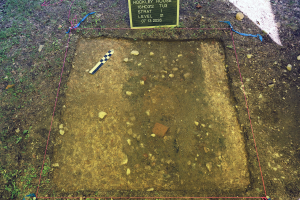
A great example of the features we look to sketch is coincidentally one of our first units. This test unit shows potential in its unique feature located in the center: a long strip of discolored soil, rock, mortar and brick remains. With time we will reveal it further, but for now it’s certainly unusual.
These test units are wrapping up this summer, but not wrapping up our research questions. This season, we decided on to place our units and shovel test pits around what would’ve been the forge master’s home, aiming to locate a potential summer kitchen and bake oven. While we’ve been happy with what we’ve been finding so far, work will continue this summer to not only wrap up our current work, but to also prep for future years! And through documenting our work through notes, detailed paperwork and this blog, the hope is that future work at Hockley will be off to a swift start next season!
This project has been financed in part with State funds from the Maryland Historical Trust, an instrumentality of the State of Maryland. However, project contents or opinions do not necessarily reflect the views or policies of the Maryland Historical Trust.